
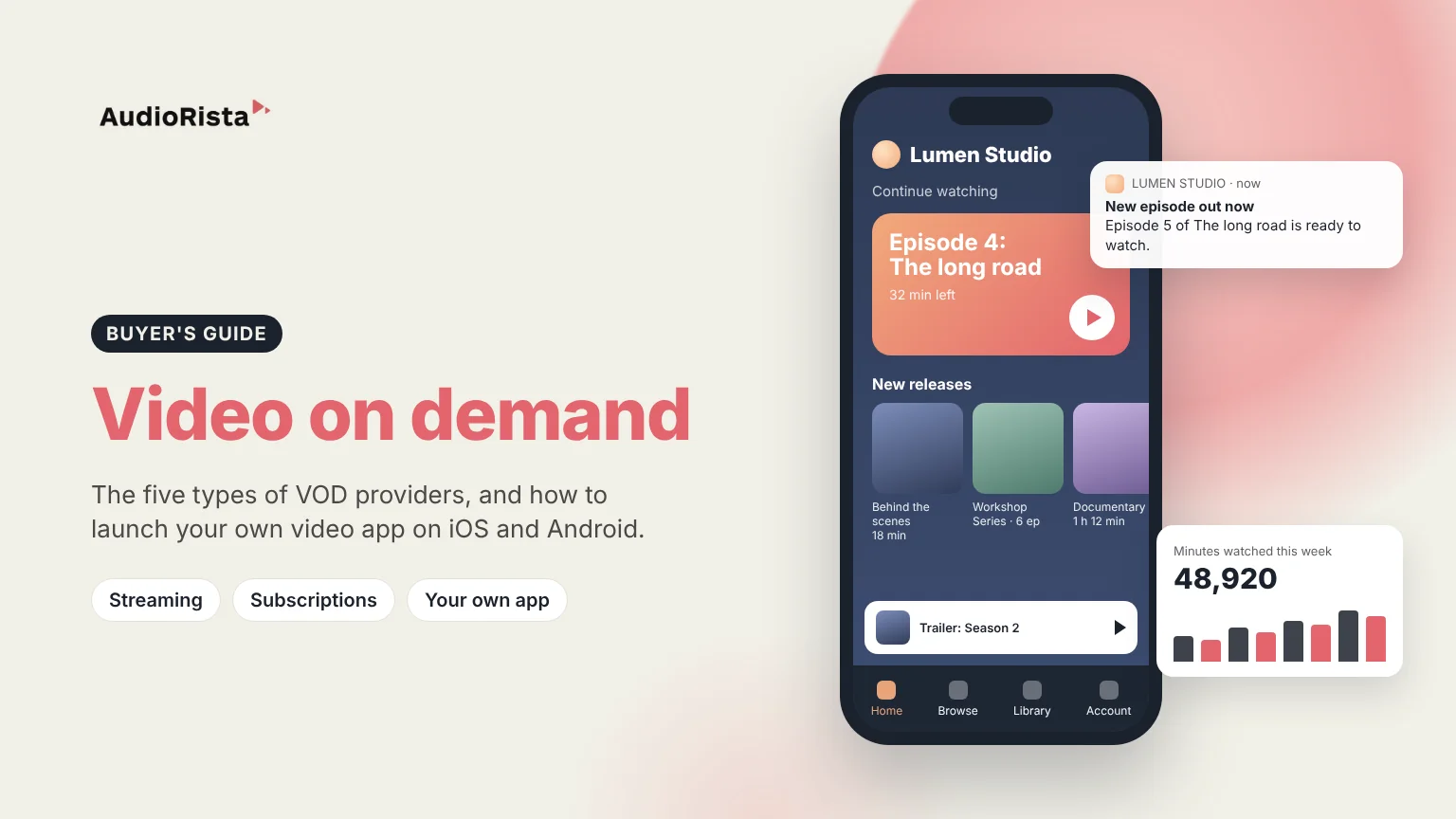
Video on demand (VOD) platform providers give you the technology to host, stream and sell video that viewers watch whenever they want. They fall into five groups: enterprise video platforms, OTT platforms, video infrastructure APIs, no-code app builders, and development agencies that build a custom solution. Which one fits depends on how much video you have, how you want to earn money from it, and whether you have developers. This guide explains each type, gives examples, and lists what to compare before you choose.
A VOD platform provider handles the parts of video streaming that are hard to build yourself:
Enterprise platforms are built for large libraries and large audiences. They are strong on video delivery, advertising and integrations, but usually need a technical team to set up and run, and pricing is normally agreed with sales.
OTT ("over the top") platforms let you run a streaming service like a small Netflix: a catalog, a paywall and apps under your brand. They are video-first, so they suit businesses where video is the whole product. Compare Audiorista and Vimeo OTT.
Infrastructure providers do the heavy lifting of storing, encoding and streaming video, but you build everything viewers see. They are a good choice if you have developers and want full control. See how Audiorista compares with Mux and Cloudflare Stream.
A no-code app builder gives you your own app in the App Store and Google Play without hiring developers. Audiorista streams video through Mux, so you get professional video delivery, and you manage videos in the same dashboard as audio and articles. That suits businesses whose content is more than video, such as courses with audio lessons, or publishers with podcasts and video.
An agency can build exactly what you specify, but you pay for the build and for every update after it. Many custom projects still use an infrastructure provider underneath.
Read more about building a video streaming app and selling videos online.
A company that supplies the technology to host, stream and sell video that viewers can watch at any time, on the web, in apps, or both.
VOD describes how video is watched: on demand, when the viewer chooses. OTT describes how it is delivered: over the internet, straight to the viewer, without a cable or satellite provider. Most OTT services are VOD services.
Three ways to earn money from video on demand: SVOD is subscriptions, TVOD is one-off purchases or rentals, and AVOD is free video paid for by advertising.
Yes. OTT platforms and no-code app builders like Audiorista let you upload videos, set prices and publish your own app without writing code.
Ready to launch your own video app? Start building with Audiorista.

